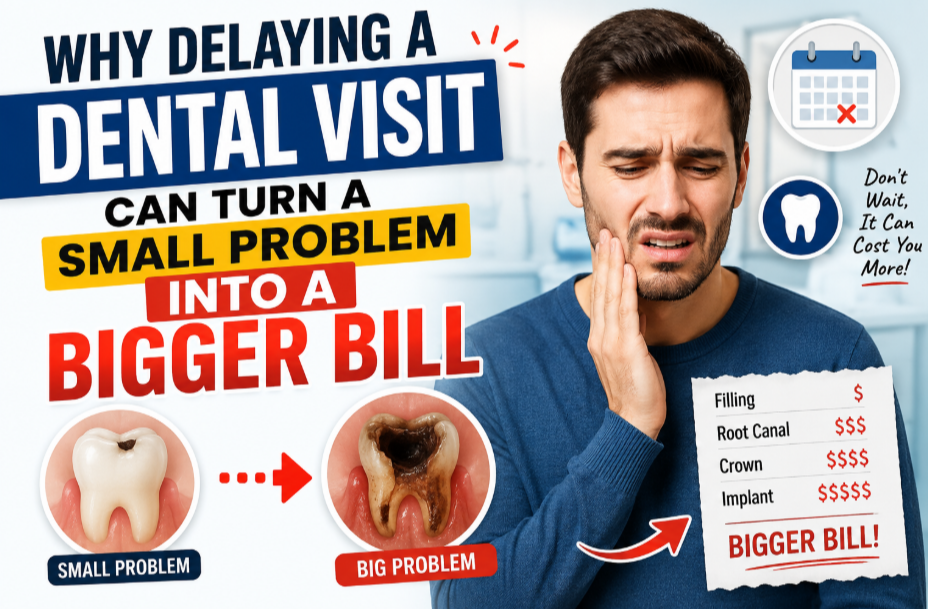
Why Delaying a Dental Visit Can Turn a Small Problem Into a Bigger Bill
You noticed it a few weeks ago — a faint sensitivity on the upper left, maybe some minor gum bleeding after brushing. You Googled it. The results mentioned root canals. Crowns. Implants. Numbers that began at $1,500 and kept climbing, real fast. Like, you just closed the tab told yourself you would handle it later and then you moved on, like nothing happened.
That decision — the one that felt financially cautious — is precisely how delaying dental treatment becomes the most expensive choice you make all year.
Most people who avoid the dentist aren’t irresponsible. They’re doing a rational calculation with bad data. The cost they’re imagining is inflated, the condition they’re avoiding is progressing, and every month that passes quietly shifts more financial burden onto their own pocket. What follows is an honest breakdown of the psychological loop driving that pattern — and exactly what it costs when the cycle goes unbroken.
The Bill You’re Imagining Is Doing More Damage Than Your Cavity
The fear of a dental bill — not the bill itself — keeps most people out of the chair. According to the National Institute of Dental and Craniofacial Research, nearly 40% of American adults cite cost as their primary reason for skipping dental care. Yet most of those patients have never received a treatment estimate for the specific issue they’re avoiding.
The mental math works like this: assume the worst, skip the appointment, keep the cost theoretical. The problem is that teeth don’t pause while that calculation runs. A check-up and early intervention in the $150–$300 range gets postponed in favor of a future bill that reaches multiples of that number.
How the Avoidance Cycle Actually Works
The Four Stages of the Loop
The avoidance cycle follows a predictable sequence:
Stage 1 — Trigger: A minor symptom appears — sensitivity to cold, a small dark spot, occasional gum bleeding. No acute pain yet.
Stage 2 — Cost Anxiety: The patient searches online. Results surface root canal costs, crown pricing, implant fees. Late-stage treatment figures dominate. Alarm replaces curiosity.
Stage 3 — Avoidance Decision: The abstract future cost of doing nothing feels more survivable than the immediate, certain cost of a visit. The appointment doesn’t get made.
Stage 4 — Silent Progression: Enamel has no nerve endings. Early decay is biologically painless. The condition advances without signaling. By the time pain arrives, the low-cost treatment window has closed — and the cycle resets at a higher price point.
Why Google Makes It Worse
When patients search dental symptoms, the information environment skews hard toward worst-case costs. Root canal and crown content dominates results because advanced treatment queries carry higher search volume and advertising value — not because they represent the likely outcome of an early-stage problem.
Patients calibrate their cost expectations against late-stage procedure pricing and treat it as the baseline. The internet, consulted for reassurance, accelerates the avoidance instead.
What the Delay Actually Costs — The Numbers That Tell the Full Story
The standard “filling vs. root canal” comparison undersells the real financial anatomy of dental problems getting worse over time. The accurate picture is a treatment cascade that compounds per tooth:
- Early enamel cavity: $150–$250 composite filling, resolved in a single visit
- Decay reaching dentin: $250–$450 filling, possible crown buildup required
- Pulp involvement: $800–$1,500 root canal plus $1,000–$1,800 crown — one tooth now costing $1,800–$3,300
- Extraction and implant path: $3,500–$6,000+ across multiple visits and months
A 12-month delay on an enamel-stage cavity can multiply dental treatment costs on that single tooth by 10 to 20 times. That’s not a worst-case scenario — that’s a documented clinical progression.
The insurance dimension sharpens the picture further. Most dental plans cover preventive visits at 100% and major restorative work at 50% or less. Every month of delay doesn’t just worsen the clinical problem — it mathematically shifts cost from the insurer’s column into the patient’s. Waiting to “save up” funds a procedure that is actively becoming more expensive than the savings accumulating to cover it.
The Decision Cost — What Not Deciding Is Actually Charging You
Most patients frame avoidance as a neutral holding position. It isn’t. Inaction carries its own invoice — arriving in three currencies at once.
Three Things Delay Costs Beyond the Dental Bill
Lost time and income: Dental-related ER visits result in an average of 1.8 lost workdays, according to the Journal of the American Dental Association. Emergency appointments run 2–3 times longer than routine visits and rarely resolve the underlying issue in a single session.
Systemic health costs: Untreated periodontal disease is clinically linked to increased management costs for Type 2 diabetes and cardiovascular conditions. The mouth is not an isolated system — ignoring it generates downstream medical spend that never appears on a dental bill.
Compounding psychological cost: dental psychology research shows that the longer the avoidance gap , the greater the anxiety at re-entry. Each passing month makes the next appointment harder to line up. The cycle gets self-reinforcing without much effort.
Coming back to dental care after a gap doesn’t automatically mean you’re signing up for a whole, costly treatment plan on day one. A properly structured diagnostic visit produces a prioritized map — what’s urgent, what can be staged, what only needs monitoring. That single visit converts an open-ended fear into a specific number the patient can plan around.
How to Exit the Cycle — Your Next Visit Is the Cheapest One You’ll Ever Have
The most expensive visit in the avoidance cycle is never the next one. It’s always the one that keeps getting postponed. Stopping delaying dental treatment at any point limits the damage — but the earlier the exit, the lower the cost of re-entry.
A phased treatment approach is, in practice, the most effective antidote to cost driven avoidance. Rather than placing a patient in front of one intimidating overall number , a prioritized roadmap kind of breaks treatment into what is clinically pressing right now, what can be arranged across the next few months, and what only requires watchful monitoring. The patient controls timing and budgeting without the condition being left unaddressed.
For patients without traditional insurance, in-house dental membership plans offer a direct alternative — covering preventive visits and providing discounted rates on restorative work with no annual maximums or claim delays. Transparent, upfront pricing at the first visit removes the ambiguity that drives delaying dental treatment in the first place.
The family dimension carries particular weight. A parent who exits the avoidance cycle doesn’t just solve their own dental problem — they interrupt a behavioral pattern before it reaches their children. Families who attend routine visits together normalize dental care as standard household health maintenance. One proactive appointment can redirect a generational pattern.
At Promise Family Dental, our team — a trusted dentist in Suffern NY — approaches every returning patient with one priority: understanding where you are now, without judgment about how long it took to get here. The next visit isn’t a reckoning. It’s a starting point.
The Cost of Waiting Is Always Higher Than the Cost of Knowing
At Promise Family Dental, we help families in Suffern, NY break the avoidance cycle through transparent treatment planning, flexible payment options, and care that moves at your pace. Whether it’s been six months or six years since your last visit, the most important appointment is simply the next one. The sooner you have a clear picture of where your oral health stands, the sooner cost stops being a fear and starts being a plan.
Frequently Asked Questions
What is the dental avoidance cycle, and how do I know if I’m in it?
The whole dental avoidance cycle is basically a pattern where worry about cost ends up causing a delay , that delay lets the problem keep moving along, which then means the eventual treatment will cost more, and that higher price sort of swells the anxiety again , so the loop continues. If you noticed a symptom, then you kind of Googled it, got quietly spooked by what it might cost, and decided to “wait and see” , you’re already inside that cycle. The clearest tell is when there’s this widening gap between the things you know really need attention, and the actual appointment that hasn’t been made yet.
Is it ever financially reasonable to delay a dental appointment?
Rarely. The logic of delay assumes the condition stays stable while savings accumulate. Dental disease doesn’t cooperate. Decay moves through enamel, into dentin, and toward the pulp on its own timeline — not yours. What costs $200 at the enamel stage can require $2,000–$3,300 in root canal and crown work within 12–18 months. Delay isn’t a financial strategy. It’s an unintentional payment plan for a larger procedure.
How does a dentist handle patients who haven’t visited in several years?
A reputable practice starts with a comprehensive diagnostic visit — X-rays, a full clinical exam, and an honest conversation. No ethical dentist schedules a full course of treatment without first establishing a clear clinical picture. Patients returning after a long gap aren’t lectured. They receive a roadmap: what needs immediate attention, what can be phased, and what only requires monitoring. The first visit is about information, not obligation.
What options exist for patients who genuinely cannot afford treatment right now?
Several pathways exist beyond traditional insurance. In-house dental membership plans provide preventive care at a flat annual fee with discounted rates on restorative work — no claim submissions, no annual maximums. Third-party financing options like CareCredit allow patients to begin treatment and manage payments over time. The key is having the conversation at the first visit rather than assuming cost makes care inaccessible. Most practices can build a viable path forward once the patient is in the room.